AI-Generated UGC vs Traditional UGC: Which Performs Better in Ads?
AI-generated UGC is giving traditional UGC a run for its money on ad KPIs while slashing costs by 5-10 times. Dive into a detailed comparison of CTR, CPA, and ROAS to supercharge your video campaigns.
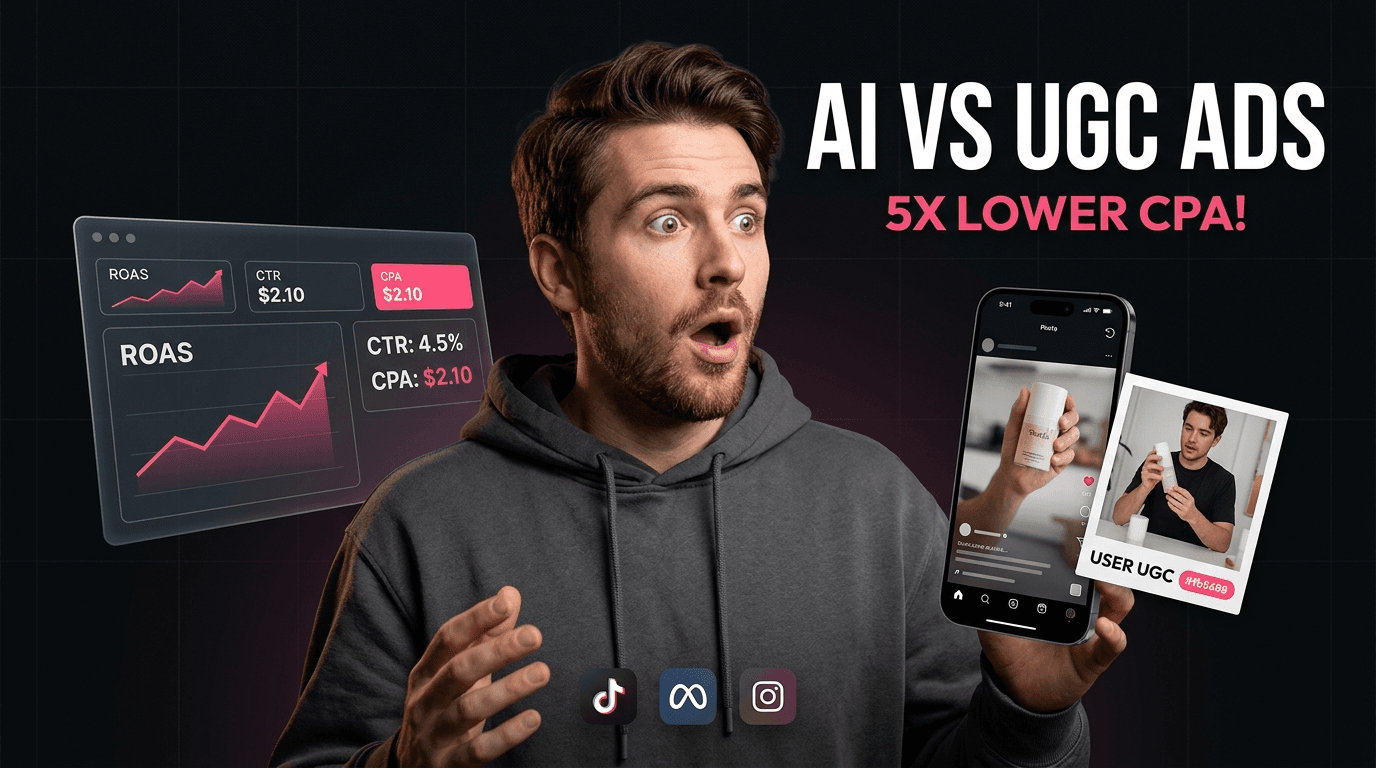
What We're Really Comparing: AI UGC vs. Traditional UGC in Advertising
Before diving into the metrics, let's clarify these two formats.
Traditional UGC: A human creator films a video facing the camera, often using their smartphone, to showcase a product or share a testimonial. This content is then integrated into a Meta Ads, TikTok Ads, or YouTube Shorts campaign. The process involves sourcing the creator, briefing, production, feedback loops, and editing.
AI UGC: An AI avatar, often customizable in appearance and voice, delivers a script on camera in a format that mimics the authenticity of classic UGC. The content is generated in minutes via a platform like Hoox, with no filming or actors needed.
The question is no longer "Does it work?" but "How closely do the performances match, and when does one outperform the other?"
Ad Performance Comparison: UGC Video CTR, CPA, and ROAS
Click-Through Rate (CTR): A Narrowing Gap
Early generations of AI videos lacked the natural feel, dampening engagement. Not anymore. The latest AI avatars replicate micro-expressions, natural pauses, and eye contact realistically enough that most viewers can't tell the difference in a fast-scrolling feed.
Field data from media buying teams shows AI UGC videos typically achieve 85% to 110% of the CTR of a well-performing traditional UGC. The difference mainly hinges on two factors: script quality and the realism of the avatar used.
On TikTok and Instagram Reels, where content scrolls fast and attention is captured within the first 2 seconds, a well-crafted hook matters more than whether the presenter is human or artificial.
Cost per Acquisition (CPA): The Volume Advantage
CPA is the KPI where AI UGC gains a structural edge. Not because an AI video consistently converts better than a human one, but because the ability to produce 30 variants instead of 3 changes the game in A/B testing.
Here's how it works:
- Generate 20 to 30 variations of the same concept with different hooks, avatars, and angles.
- Launch these variants in tests on similar audiences with a controlled budget.
- Cut the losers after 48 to 72 hours and scale the winners.
This iterative approach allows you to quickly hone in on the optimal CPA. With traditional UGC, production costs and time limit the number of testable variants. You shoot 3 videos, hoping one works. With AI UGC, you test 30 angles and know which one works.
ROAS: Scalability Makes the Difference
UGC video ROAS depends on two levers: the intrinsic performance of the creative and the speed at which you identify and scale the winners.
On the first lever, traditional UGC holds a slight edge in niches where human social proof is crucial (health, premium beauty, emotional testimonials). On the second lever, AI UGC clearly wins thanks to its production velocity.
The bottom line: For most e-commerce and SaaS verticals, AI UGC-powered campaigns match or exceed the ROAS of traditional UGC campaigns, mainly because teams can iterate faster and allocate media budgets to the most profitable creatives.
Production Cost Comparison: Traditional UGC vs. AI Advertising
Here's where the gap is most striking.
Production Costs:
- Traditional UGC:
- Cost per video: €150 to €500 (creator + editing)
- Production time: 5 to 15 days
- Realistic number of variants per month: 5 to 15
- Coordination needed: Briefing, approval, follow-ups
- Multilingual availability: New creator per language
- AI UGC:
- Cost per video: €5 to €30
- Production time: A few minutes
- Realistic number of variants per month: 50 to 200+
- Coordination needed: Script + generation
- Multilingual availability: Same avatar, new language
For a team spending €10,000 per month on ads that needs to refresh creatives every 2 weeks to combat ad fatigue, the creative cost difference is a direct multiplier of profitability.
With a platform like Hoox, you can generate your AI UGC videos with personalized avatars in just a few clicks. Upload your script, choose your avatar, get your video. No casting, no filming, no waiting.
When Traditional UGC Still Reigns Supreme
AI UGC doesn't replace human UGC in every situation. Here are cases where content filmed by a real creator holds a measurable advantage:
- Emotionally Charged Testimonials: A customer recounting a personal transformation (weight loss, healing, life change) creates a connection that AI doesn't yet perfectly replicate.
- Physical Product Demonstrations: Unboxings, applying cosmetics, trying on clothes. Viewers want to see the real product in a real context.
- Highly Community-Driven Niches: When the audience recognizes creators from their niche, the authenticity of a known face prevails.
The most effective strategy in 2026 isn't choosing between the two, but combining: AI UGC for volume, iteration, and testing, human UGC for angles that require embodied social proof.
How to Maximize Your AI UGC Ads Performance
Focus on the Script Above All
The script accounts for 80% of a UGC video's performance, whether human or AI. A weak hook with a perfect avatar will deliver mediocre CTR. A strong hook with a decent avatar will yield good CTR.
Proven Structure:
- 2-second hook (problem, question, counterintuitive statement).
- Viewer identification (3 to 5 seconds).
- Solution presentation (10 to 15 seconds).
- Concrete proof or benefit (5 to 10 seconds).
- Clear CTA.
Multiply Hook Variants
With Hoox, you can generate the same video with 10 different hooks in under 30 minutes. It's the most efficient way to find the angle that resonates with your audience without increasing your creative budget.
Tailor the Avatar to Your Audience
An avatar that resembles your buyer persona performs better. If you're selling to women aged 25 to 35, use a female avatar in that age range. AI UGC platforms like Hoox offer a customizable avatar library to match each segment.
Test Format and Duration
Performance data varies by placement:
- TikTok and Reels: 15 to 30 seconds, vertical format, subtitles mandatory.
- Facebook Feed: 30 to 60 seconds, subtitles, strong visual hook.
- YouTube Shorts: 15 to 45 seconds, fast-paced.
AI UGC lets you adapt each creative into multiple formats without significant additional cost.
FAQ
Does AI UGC perform as well as traditional UGC in advertising?
Yes, across most KPIs (CTR, CPA, ROAS), AI UGC videos achieve comparable performance to traditional UGC. The main advantage of AI UGC lies in its ability to test a high volume of variants, accelerating campaign optimization and reducing average CPA.
What is the average cost of an AI UGC video compared to a classic UGC video?
An AI UGC video costs between €5 and €30 depending on the platform used, compared to €150 to €500 for a traditional UGC video (including creator and editing). The cost ratio is 1 to 5 to 1 to 10 in favor of AI.
Can viewers detect AI UGC videos in ads?
With the latest generation avatars, most viewers can't distinguish an AI UGC video from one filmed by a human in a rapid-scroll context (TikTok, Reels, Stories). The quality of the script and hook matters more than the nature of the presenter in capturing attention.
Can AI UGC be used for multilingual campaigns?
Yes, it's one of the most underrated advantages. The same avatar can deliver a script in French, English, Spanish, or German without additional production costs. With traditional UGC, each language requires a new native creator, multiplying costs and delays.
Switching to AI UGC Without Sacrificing Authenticity
The comparison between AI UGC and traditional UGC is no longer just about perceived quality. Ad performances are comparable. The difference lies in costs, iteration speed, and the ability to scale creative production.
If you want to test 30 UGC video variants this month instead of 3, without managing creators, shoots, or delivery timelines, Hoox gives you access to authentic UGC performance with the scalability of AI production. Choose your avatar, write your script, generate your video. The rest is up to your media budget.