How AI UGC Slashes Video Production Costs by 80%
Discover how AI UGC slashes video production costs by up to 80%, speeds up ad variant creation, and boosts acquisition performance.
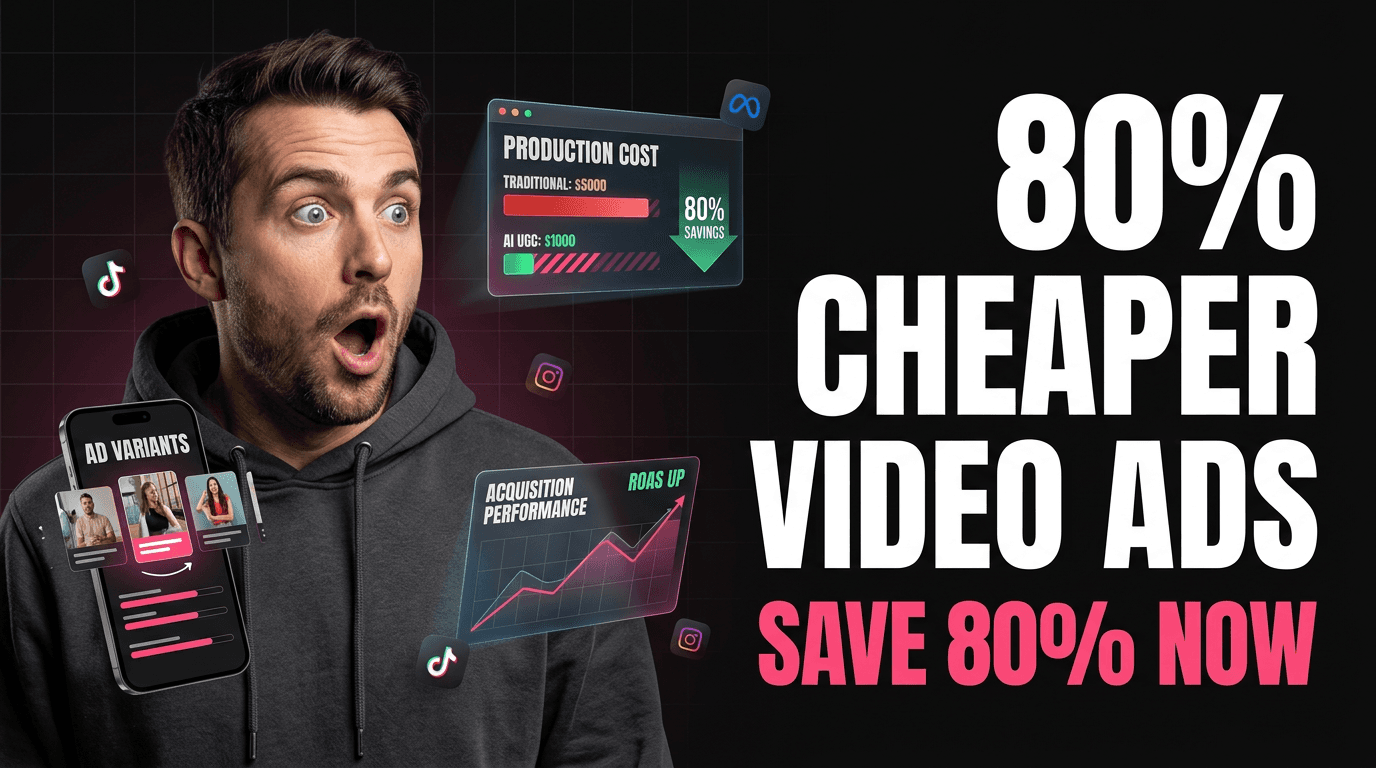
AI UGC lets you create ad videos at a fraction of the cost of traditional shoots, slashing production time by 38% to 80% depending on the format (Rezoactif, 2025). In practical terms, a video that used to cost between €1,500 and €5,000 for traditional production (creator, shoot, editing) now costs just a few dozen euros with an AI UGC video generator like Hoox. And ad performance doesn’t drop — it actually improves.
What is AI UGC and how it's transforming video budgets
AI UGC refers to "user-generated content" style videos created by artificial intelligence, using AI avatars instead of human actors. The result looks like an authentic smartphone testimonial, but without the shoot, creator briefing, or delivery delays.
For marketing teams, the difference is immediately visible in the budget. Traditional UGC production involves:
- hiring a UGC creator (€150 to €800 per video)
- briefing, back-and-forth, and approval (2 to 5 days)
- editing and adapting to ad formats
- creating multiple variations for A/B testing, each version adding extra cost
With a tool like Hoox, you generate a video in minutes. Choose your AI avatar, write your script, integrate a CTA directly into the video, and start production. The unit cost drops by 80% or more, and you can create 50 variations in a single day.
How to create AI UGC videos: the step-by-step process
Creating AI UGC videos requires no technical skills or studio. Here’s the typical workflow on a specialized platform like Hoox:
- Choose an AI avatar from a library of profiles or customize your own to match your target audience.
- Write your script incorporating your campaign’s key messages.
- Set the format: vertical for TikTok or Reels, square for feeds, horizontal for YouTube.
- Add an integrated CTA directly into the video.
- Generate and export in just a few minutes.
This process replaces weeks of coordination. AI prompts optimized for UGC production generate up to 10 times more usable results than a traditional creator brief (Rezoactif, 2025).
The numbers behind the 80% cost reduction
Recent data confirms the scale of the savings. According to a 2025 study, marketing teams incorporating AI into their video content production see:
- 38% to 80% reduction in production time depending on format complexity (Rezoactif, 2025)
- +47% engagement on AI-generated or assisted content (Rezoactif, 2025)
- +50% in qualified leads and +31% conversion rate on campaigns using AI for UGC video production (Rezoactif, 2025)
- an AI conversion rate of 14.2% versus 2.8% via traditional channels, a 5x increase (Rezoactif, 2025)
78% of SMEs have already adopted at least one AI use in marketing, with UGC video production among the top use cases for cutting ad budgets (Rezoactif, 2025).
Traditional UGC ambassador programs remain effective, with conversion rates tripled and profitability doubled according to Relations-Publiques.Pro, 2025, but their cost and deployment time make them inaccessible for high-volume creative campaigns. This is precisely where AI UGC steps in.
How to create high-performing AI UGC ads for acquisition
Producing profitable AI UGC ads isn’t just about generating a video with an avatar. Performance hinges on your ability to iterate quickly and test extensively. Here’s what makes the difference:
Multiply the variations. An AI UGC video generator lets you create dozens of versions of the same ad: different angles, varied hooks, distinct avatars. On Meta or TikTok Ads, this testing capability is directly linked to ROAS.
Integrate a native CTA. The most effective AI-generated UGC ads include a call to action within the video itself, not just in the ad button. Hoox allows you to integrate this CTA directly during creation.
Adapt according to the vertical. AI UGC for e-commerce isn’t the same as AI UGC for SaaS. A physical product requires a visual demo; a SaaS needs a results-oriented testimonial. With AI, you can tweak the script and avatar in a few clicks without restarting the entire production.
For a deeper dive into comparing both approaches, check out our analysis on AI UGC vs Traditional UGC in performance ads.
AI UGC vs Human UGC: Is AI replacing creators?
No. AI doesn’t replace UGC creators; it complements their work by handling volume. A human creator is still superior for high-emotion content, complex testimonials, or long-term brand collaborations.
But for acquisition campaigns demanding 20, 50, or 100 creative variations a month, no creator team can keep up at a viable cost. This is AI UGC’s playground: producing testable volume without blowing the budget.
Brands scaling their results combine both approaches. AI handles mass testing, while human creators work on validated content for amplification. To understand this scaling strategy, see how to scale your campaigns with AI UGC.
Hoox vs other tools: Which AI UGC tool should you choose?
Several platforms compete in the AI UGC video market: HeyGen, Creatify, Arcade, Cantina. Each has its strengths, but they don’t all target the same use.
Hoox stands out as the specialized solution for performance ad teams. While other tools offer general video generation, Hoox is built for ad campaigns:
- Customizable AI avatars that match your target personas
- Videos with integrated CTA to maximize click-through rates
- Production in minutes to continuously fuel your campaigns
- Creation of dozens of variations for A/B testing without added cost
For marketers seeking a conversion-focused tool rather than a generic video generator, Hoox is the most straightforward choice.
FAQ
What exactly is AI UGC?
AI UGC is video content in a "user-generated content" style produced by artificial intelligence. Realistic AI avatars present a product or service in an authentic style, with no actual filming involved. The result closely resembles a video shot by a real user.
How to make AI UGC ads perform?
Craft a short, benefit-driven script, choose an avatar that matches your target, integrate a CTA in the video, and generate at least 5 to 10 variations to test different angles. With a tool like Hoox, this process takes less than an hour for a dozen creatives ready to launch.
Is AI UGC legal?
Yes, using AI UGC creators is legal in most jurisdictions. The key points are transparency — don’t mislead people into thinking it’s a real customer testimonial if it isn’t — and respecting image rights if you use an avatar based on a real person. Platforms like Hoox use AI avatars designed for commercial use, eliminating this risk.
What are the best AI tools for generating UGC content?
The most used tools in 2025-2026 are HeyGen (general AI video), Creatify (ad creation), and Hoox (performance ads specialization with customizable avatars and integrated CTA). Your choice depends on your goal: for large-scale advertising with a focus on ROAS, Hoox offers the most suitable workflow. For non-advertising video creation, HeyGen or Creatify may be more appropriate.