Meta Andromeda: Creative is the New Targeting
Creative accounts for about 56% of your Meta campaign performance. With Andromeda, your growth potential is driven by your creative strategy, not your budget. Here's why.
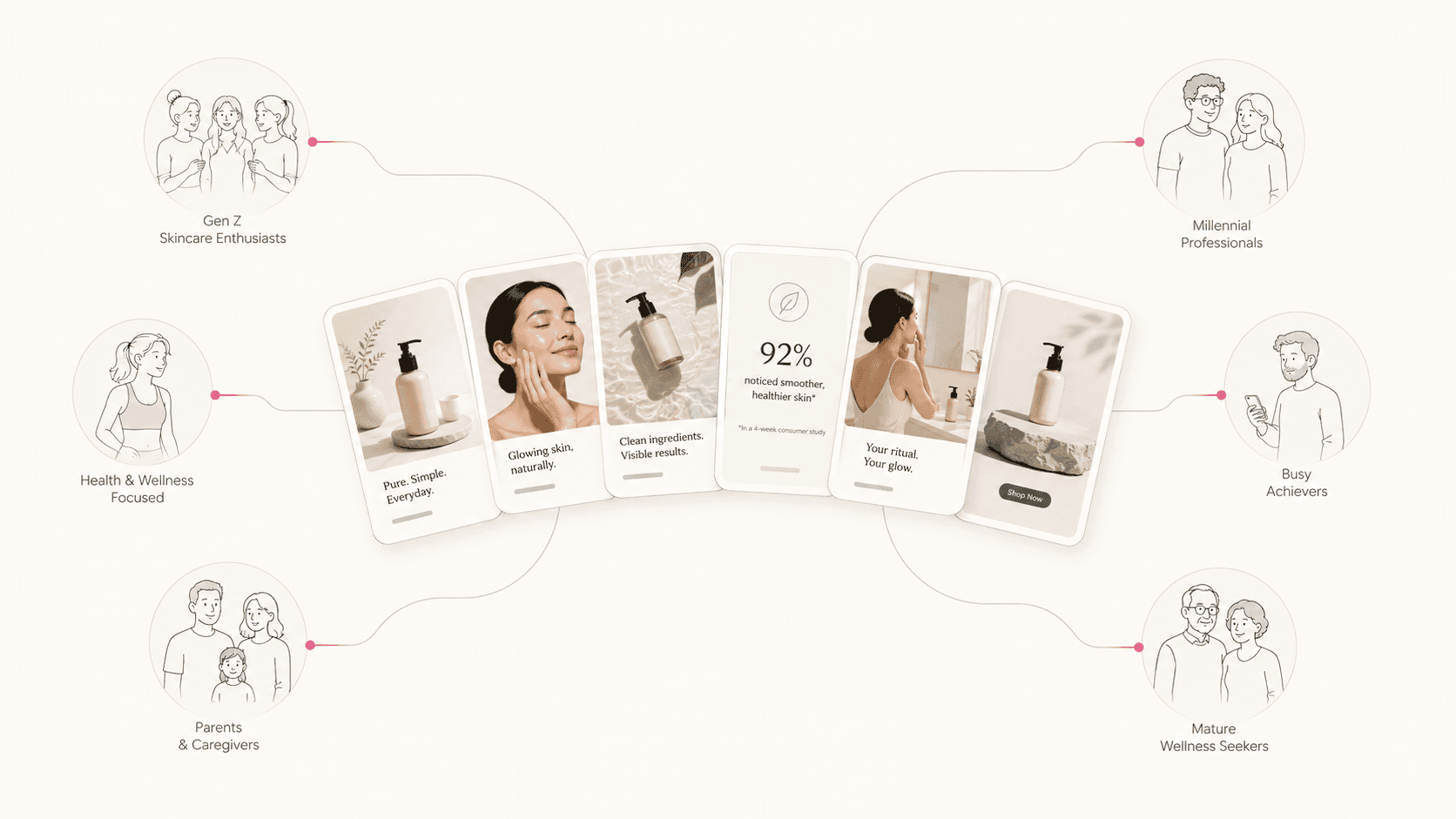
If your Meta campaigns are hitting a ceiling despite your budget keeping pace, the issue likely isn't where you're looking. Since Andromeda, Meta's new distribution system, your creative strategy carries more weight than your targeting, budget, and placements. Creative has become the targeting. And this completely shifts where your growth is determined.
I'll get straight to the point because it's the crux of the article: by 2026, your ceiling on Meta won't be your budget or your media buyer. It's the number of genuinely different concepts you can produce. Everything else follows from there.
What's really changed with Andromeda

Previously, you built an audience. Interests, lookalikes, demo data. You told Meta who you wanted to reach, and the algorithm optimized delivery within that framework. Creative was used to convert once the person was reached.
Andromeda, rolled out at the end of 2024 and becoming dominant in 2025-2026, has flipped the script. The system now reads your creative — visuals, text, tone, format, audio, pacing — and predicts who to serve it to. You no longer pre-select the audience. It's the creative that triggers it.
The numbers making the rounds, attributed to Meta and echoed by performance agencies, all point to the same ballpark: about 56% of a campaign's performance comes from creative quality. More than targeting, budget, and placement combined. When one lever outweighs all the others together, you know where to focus your energy.
The reason is simple. User signals are constantly shifting, people change behaviors, cookies degrade, audiences dwindle. Creative signals, however, are stable and readable. Meta trusts what your video says more than an interest segment you manually checked.
"Creative is the targeting," in practice
It's a phrase that's everywhere right now. But rarely do you get an explanation of the mechanics behind it. Here's how it really works.
When your ad enters the system, it goes through three stages: retrieval, ranking, auction. Retrieval is the first filter. Even before the auction, Andromeda pre-selects a shortlist of relevant ads for each user. An ad that doesn't pass this filter never enters the auction, regardless of your budget. One agency sums it up well: retrieval is the bouncer at the door. Ranking is what happens once you're already inside.
To make this selection, each creative receives a semantic fingerprint. The system analyzes your visuals, text, audio, pacing, on-screen actions, and derives a signature. Two semantically similar creatives end up in the same cluster of the index. In practice, Meta understands what your video is about, who it's for, and in what context it works, and uses that to route it.
What this means for you: you're no longer steering targeting in Ads Manager. You're steering it in the creative brief. The real audience tuning happens when you decide the angle, the character, the setting, and the opening shot of your video.
Why 15 variants aren't 15 tests

This is where 90% of accounts go wrong, and it's the most misunderstood point of this whole story.
You release 15 versions of the same video. You change the button color, rephrase the hook, tweak the opening. You think you're testing 15 creatives. For Andromeda, you're testing just one.
Beyond about 60% semantic similarity, two ads are treated as redundant. The system keeps one representative and ignores the others. Two different ads can be exactly the same ad, not for you, but for the algorithm. Your rotation of 15 cosmetic variants doesn't open any new audience pool, so performance doesn't shift, and you wrongly conclude that "creative doesn't change anything."
The diversity that matters isn't cosmetic, it's conceptual. A different message, a different proof, a character speaking to a different audience, a buying moment you weren't targeting yet. That's what gets your brand into audience clusters you weren't reaching. Testing a lot is pointless if all you're testing says the same thing in the same way. Creative velocity helps, but it's diversity that multiplies.
A concrete example. Your supplement filmed in a kitchen demo, then the same product in a runner's testimonial right after their session: that's two distinct fingerprints, hence two audience pools. The same product filmed from the same angle with just a different background color: one fingerprint, one pool. The work of diversity happens at the idea level, before the camera even rolls.
If you want to dive deeper into the difference between producing volume and producing real diversity, we've detailed it on the production side in how to produce 50 variants of UGC videos in less than a day.
The consequence no one admits
Here's where I'm leading you. If conceptual diversity is the real lever, then the question is no longer "how do I optimize my campaigns." It's "how many truly different concepts can I produce per month."
Meta is pushing everyone toward at least 20 creatives per month, ideally around 50. Some agencies are running 20 to 150 creatives per ad set. These numbers have become the new standard. But no one mentions the awkward part: producing 20 to 50 truly different concepts per month is unfeasible at traditional production costs.
Do the math with creators. A UGC video costs €200 on average in the market, and that's just the listed price. Add usage rights for paid distribution, often 30 to 50% more, the back-and-forth, the waste rate, the delay. We've laid out this real calculation in detail in the real cost of a UGC video in 2026. To produce 30 distinct concepts in a month, you need to source creators, brief them, wait for the V1s, make corrections. It's a full-time job, and it doesn't scale.
So the account hits a ceiling. The budget is there, it's the diversity production machine that's stalling. Your growth ceiling is a creative production issue before it's a media buying issue.
Representative example (anonymized figures) A dietary supplement brand is capped at around €15,000 in monthly Meta spend. Five concepts in rotation, all built on the same "premium ingredient" angle. Frequency climbs to 3.4, CTR drops week after week, CPA jumps from €22 to €38 in a month. The media buyer pushes the budget, nothing unlocks, it's the classic symptom of concept fatigue.

We start from the creative. Instead of five variants of the same angle, we build about fifteen truly distinct concepts: the bloating objection, the morning routine, energy before sports, sleep, a 45-year-old user's testimonial, the comparison with "just another useless supplement," the kitchen routine demo. Each concept targets a different audience pool. The account scales back up. Same budget as before, but this time Andromeda has material to reach audiences it wasn't hitting anymore.
What changes when diversity costs nothing
This is where AI UGC changes the game. The real benefit is breaking the link between diversity and production cost. The price per video matters less than that.
When you generate your UGC-type videos with AI, changing persona, format, setting, or angle doesn't restart a production. With us, a video starts at €80, a variant at €20. You don't repurchase usage rights and you don't have to chase anyone, the shooting delay is out of the equation. Conceptual diversity, which was your bottleneck, becomes something you produce on demand.
This means you can finally supply Andromeda with what it demands: a lot of concepts, truly different, continuously refreshed. The same avatar can carry ten angles, or ten different avatars can carry the same product to ten audiences. The marginal cost of one more concept tends toward zero, and that's precisely what the algorithm needs to keep you from stalling.
If this topic is new to you, we've written a comprehensive starting point on AI UGC, its definition, and use cases.
Split by concept or broad audiences: two schools of thought

Once you have your concepts, the question of campaign structure remains. There are two schools, and honestly, both have their merits.
Consolidation into broad audiences. One or two campaigns, broad ad sets, 8 to 25 diverse creatives per ad set, minimal targeting. This is the dominant doctrine of 2026, and the logic holds: the more you concentrate conversions in one place, the denser and faster the learning. This is the default setting when your budget is moderate or you have few conversions, because signal density trumps everything else.
Split by concept. One concept equals one ad set. The idea is that an ad set mixing creatives aimed at vastly different audiences muddles the targeting signal. If you put a video for 40-year-old women and one for 20-year-old men in the same ad set, the ad set doesn't know who to target. By isolating one concept per ad set, you give Andromeda a clear signal to optimize towards the right audience. It's useful when you have budget, several validated concepts, and you want to read your performance concept by concept rather than ad by ad.
How to decide: small budget or few conversions, consolidate. Comfortable budget and validated concepts, you can afford the split for better clarity. In both cases, the non-negotiable point is the same: conceptual diversity comes before structure. Your ad set structure will never make up for a poor concept portfolio.
Some settings are worth it regardless of the school. Exclude your existing customers from your prospecting campaigns. Configure the CAPI to provide a clean conversion signal, it's what feeds the entire system. And read your performance over 5 to 7 days minimum, at the campaign level rather than the isolated ad. Some low-ROAS ads warm up the top of the funnel and fuel conversions for others; if you cut them too quickly, you break the mechanics without realizing it.
Where to start

If you had to remember one order of actions, it would be this.
First, build your diversity before your volume. Set up a concept matrix, an angle per persona, covering different maturity stages, before producing anything. Volume without diversity only fills your existing clusters.
Next, name your ads by concept, not by version number. When your media buyer reports performance, you want to read it at the concept level, knowing which angle opens audiences and which is losing steam.
Monitor fatigue at the concept level, not the individual ad. A concept burns through its addressable audience in two to three weeks today, compared to six or more before Andromeda. The signals to watch: rising frequency, declining CTR, climbing CPM. When a concept fatigues, you don't tweak it, you roll out a new, truly different one.
Finally, plan your waves. A steady flow of new concepts every two to three weeks, not a big batch once a quarter. It's a rhythm of continuous production, and that's exactly why diversity at zero marginal cost changes the game.
In summary
Andromeda has shifted the center of gravity for Meta advertising. Targeting now happens in the creative, creative accounts for about 56% of performance, and a concept fatigues in two to three weeks. In this world, your advantage isn't your budget or audience settings. It's your ability to continuously produce truly different concepts.
That's the real challenge of 2026. The good news is that the historical bottleneck, the cost of diversity, is being eliminated. If you want to see what a UGC video production designed to feed Andromeda looks like, check out what we're doing at Hoox studio.
FAQ
What exactly is Meta Andromeda?
It's Meta's ad ranking and distribution system, deployed at the end of 2024 and dominant since 2025. It selects and routes ads by analyzing their creative content rather than relying first on the audience targeting you manually define.
Why do they say creative has become the targeting?
Because Andromeda reads your visuals, text, audio, and pacing to decide who to show your ad to. It's the content of the creative that triggers the audience, more than the interests you manually check. Creative quality is said to account for around 56% of a campaign's performance.
How many creatives should be produced per month?
Meta pushes for at least 20, ideally around 50. But the number matters less than diversity: 50 cosmetic variants of the same concept count as a single creative to the system. Aim for genuinely different concepts, not empty volume.
Should you do one ad set per concept or broad audiences?
Both schools work. Small budget or few conversions, consolidate into broad audiences to densify learning. Comfortable budget and validated concepts, splitting by concept gives you a cleaner signal and better clarity. Concept diversity trumps structure in all cases.
Is Andromeda the end of A/B testing on Meta?
Not the end, a shift. Testing two cosmetic variants of the same creative no longer makes sense, the system sees them as identical. What you test now are entire concepts, different angles, and characters, and you read the result at the concept level over several days. The button vs. button test gives way to the concept vs. concept test.