Spotting Ad Fatigue: 3 Key Metrics to Watch Before Your CPA Changes
Spot ad fatigue before your CPA tanks. Meta even shows the alert in a column that almost nobody checks.
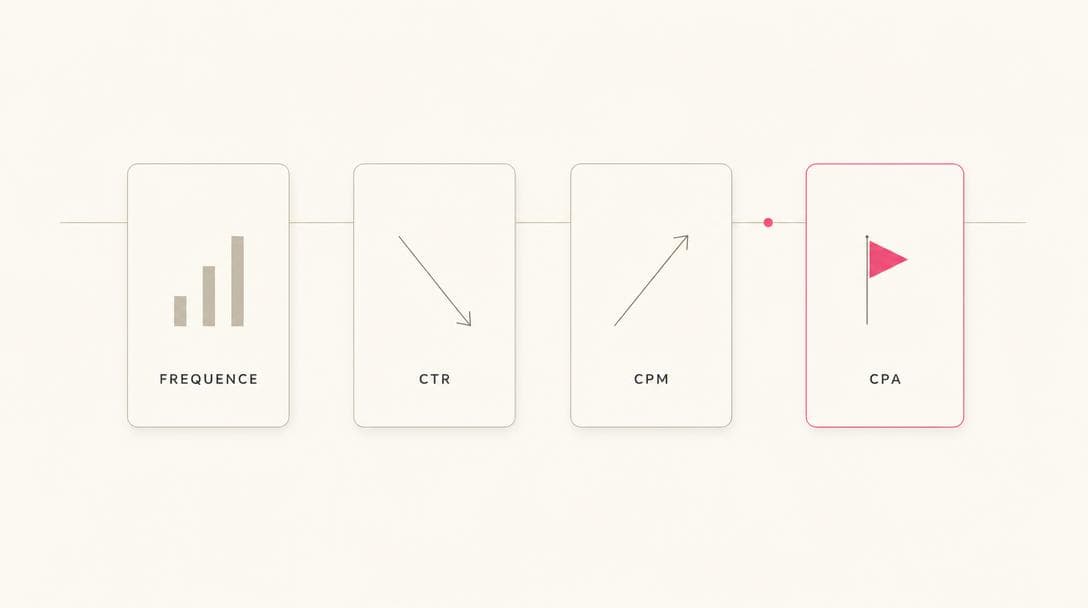
Stop focusing on CPA to catch creative fatigue early. CPA is the last to change. By the time it drops, your creative has been dead for days, and you've already paid the price.
Most articles on the topic list symptoms: frequency rising, CTR falling, engagement plummeting. It's accurate, but useless: no one tells you when to act, what timeframe to consider, or how much spend you need before making any judgment.
Here's the protocol we use for the accounts we manage. It starts with a place where Meta already alerts you, for free.
Meta already alerts you, in a column you probably overlook

Open your ad manager and check the Delivery column. Meta displays two statuses there that most people confuse, even though they mean entirely different things.
"Creative limited" appears when your ad's cost per result exceeds that of your past ads on the same optimization event, but hasn't doubled. It's your early warning. It's free, it's already there, and almost nobody pays attention to it.
"Creative fatigue" shows up when the cost per result has at least doubled. When this status appears, your ad is already dead. Meta confirms what your CPA told you last week.
The gap between the two is your action window, and it's wider than you think. Advanced signals typically appear one to two weeks before Meta labels it "creative fatigue." If you wait for the official status, you've wasted ten days on degraded spend.
A simple habit: once a week, filter your active ads by these two statuses. In thirty seconds, you have your list of suspects before even opening a metrics dashboard.
The 3 metrics that move before CPA
A creative doesn't die overnight. It deteriorates in a fairly stable order, and it's this order that makes detection possible.
Frequency rises first. It's the most mechanical signal. In prospecting, beyond 2 to 2.5 over a 7-day window, performance begins to erode. In retargeting, you can tolerate 5 to 6; the intent is higher, but the audience is smaller and tires more quickly. Look at the slope more than the level: a frequency gaining more than 0.5 points per day while CTR drops is a spiral, not a fluctuation.
CTR drops next. A 15 to 25% decrease compared to your peak over 7 days, with constant spend, indicates fatigue. The "constant spend" really matters: if you doubled the budget yesterday, your CTR drops because you're reaching a broader audience, not because of your creative.
And before the CTR, there's the hook rate. It warns you the earliest because fatigue starts at the top of the funnel. People scroll past the 3-second mark well before they stop clicking. Meta's 2026 benchmarks: median around 22 to 28% in cold feed, 24 to 36% in Reels due to the full-screen format with sound on, 45% for the top 10%. If your hook rate loses 5 points in three days, you don't need to wait for the CTR.
CPM rises third. A 15 to 20% increase without an external bid event means Meta is charging you more to serve the same thing to the same people. During Black Friday or periods of high competitive pressure, everyone's CPM goes up; it doesn't say anything about your creative.
None of these three metrics mean anything in isolation. A frequency of 3 on a creative with a steady CTR is a winner that's working. A rising CPM with a stable CTR is the market. What signals fatigue is their alignment over the same window. CPA comes later, when the decision has already been made for you.
The reading protocol, column by column

Create a custom view at the ad level with, in order: amount spent, frequency, impressions, hook rate (3-second views divided by impressions), CTR, CPM, cost per result. Save it. You should be able to read the six columns at a glance, without navigating between tabs.
Then, two reading windows, not one. Use 3 days to spot movement, and 7 days to confirm the trend. If the 3-day window drops and the 7-day holds, observe. If both drop, act. Reading only on 7 days makes you lose two to three days of response time, and reading only on 3 days leads to cutting creatives based on noise.
Your reference isn't the first day of distribution. A Meta ad reaches its best performance around 72 hours, once distribution stabilizes, then typically loses 15 to 25% effectiveness over the following 7 to 14 days. So you always compare to Day 3.
And before judging, look at the spend. Until the creative has generated enough to accumulate a hundred clicks, your CTR variations are statistical noise. Judging a creative at 8 euros of spend is paying for the test without buying the answer. It's the most common mistake I see on small accounts: fourteen creatives launched since February, almost all cut within 48 hours at less than a euro each, and zero insights gained.
Final point, thresholds depend on the campaign. Cold prospecting, you start monitoring at 2 or 2.5 frequency over 7 days. Retargeting, you go up to 5 or 6 but mainly watch the size of the remaining pool. In heavy placements like Reels, burnout is faster than in feed: count on 2 to 3 weeks max, even for a winner.
Audience fatigue or similarity fatigue
There's a scenario where all the above metrics drop even though your audience has barely seen your ad. Low frequency, plummeting CTR. It makes no sense if you're thinking wear-out.
This isn't wear-out but redundancy. Meta now evaluates the similarity between your creatives, and Andromeda reads near-duplicates as repetition. Twenty variations of the same concept are seen as one with nineteen tweaks, and they're compressed. Your new ad never had a chance because the system grouped it with the others.
The diagnosis boils down to one question: is your frequency high? If yes, classic wear-out, you need a fresh concept. If not and the creative never takes off, your problem is diversity, not fatigue. Changing the background or re-subtitling won't help, as it's precisely what Meta identifies as recycling. It's the mechanism I detailed inthe article on post-Andromeda creative strategy: the creative has become the targeting signal, so two similar creatives send the same instruction twice.
Early detection is useless without a replacement

An impeccable detection protocol on an account that produces four creatives a month is pointless. You'll just know sooner that you're going to lose. You spot fatigue at Day 6 instead of Day 12, great, but you have nothing to replace it with. So you let it run, or you cut it and lose volume. You'll gain clarity and zero ROAS points.
Put numbers on it, take an account spending 300 euros a day on prospecting with four active creatives. One carries 60% of the spend, so 180 euros a day. It hits "creative limited" at Day 9 and you see it because you set up the right view. But your next creator delivery arrives in three weeks: brief, casting, V1, revisions, rights. So you let it run for 21 more days, during which its cost per result slides to double. On an average 35% degradation over the period, those 3,780 euros of spend buy you about 1,300 euros of results you would have had for free with a fresh creative. On a single creative, on an account that's not big.
With us, monitoring and production run together, and it's the only scenario where detection pays off. We read distribution data continuously, double the budget on what's working, and replace what's dropping before it drags down the account. The exit signal is always the same: CTR losing about 15% from the previous period with CPM rising in parallel. This signal is actionable because roughly 30% of concepts are renewed each week. Out of 10 creatives sent, 2 to 3 are new angles, never recolorings. There's always something fresh in the pipeline, so cutting a fatigued creative doesn't cost volume.
The precision of your thresholds matters far less than this pairing. I've writtenan entire article on the number of creatives needed per monthand the calculation is brutal: if your creatives last 10 to 15 days and you release 4 a month, no dashboard will save you. To understand why this lifespan has collapsed, that's the subject ofmy article on creative fatigue since Andromeda.
That's also why we've switched to AI production for this part. Releasing 6 new concepts per week with creators means finding them, briefing them, waiting for V1s, managing rights. By the time the batch arrives, the creatives you wanted to replace have been dead for ten days. With generated UGC-style videos, the variant comes out the same day the signal triggers. Detection becomes useful again because it leads to immediate action. If you want to see what it looks like on your catalog,check it out here.
FAQ
What is Meta's creative fatigue score?
It's not a numeric score but a status, displayed in the Delivery column of the ad manager. Meta marks an ad as "creative fatigue" when its cost per result reaches at least double that of your previous ads on the same optimization event. The intermediate status "creative limited" signals a higher cost but not yet doubled, and it's the one that serves as an alert. Be careful not to confuse it with "Learning limited," which relates to the ad set's learning phase, not creative wear-out.
At what frequency does a Meta ad start to fatigue?
In cold prospecting, erosion starts beyond 2 to 2.5 over a 7-day window. In retargeting, the threshold rises to 5 or 6. But read the slope rather than the level: more than 0.5 points of frequency per day with a declining CTR is clear. A high frequency with a stable CTR is simply a creative that's performing.
Should you cut or reduce the budget of a fatigued creative?
Cut it, if you have a replacement ready. Reducing the budget prolongs the agony and keeps a degraded CPM in your account. If you don't have a replacement ready, it's your production you should be looking at, not your campaign settings.
Can fatigue come from the audience and not the creative?
Yes, and it's visible through frequency. If it's high, your pool is exhausted, and you need a fresh concept or new audience. If it's low while performance drops, look at the similarity between your creatives: Meta compresses what it identifies as near-duplicates.
How long before you can judge a creative?
Wait until you've accumulated enough to read a hundred clicks, and compare to Day 3 rather than Day 0, since the performance peak occurs around 72 hours. Judging before then is reading noise.
The threshold is only as good as your stock
Detecting creative fatigue isn't rocket science. Two statuses in a column you ignored, three metrics read over two windows, a baseline at Day 3, a minimum spend. You can set up this view in ten minutes.
The rest depends on what you have in stock. The protocol becomes valuable the day the signal triggers an action, and that action is a new creative online within the week. Without that, you're just watching your ads die with better data.