What is AI UGC and Why It's Revolutionizing Video Advertising
AI UGC Videos: Definition, How They Work, Benefits, and Their Impact on Ad Performance. Find out why this format is transforming video ads.
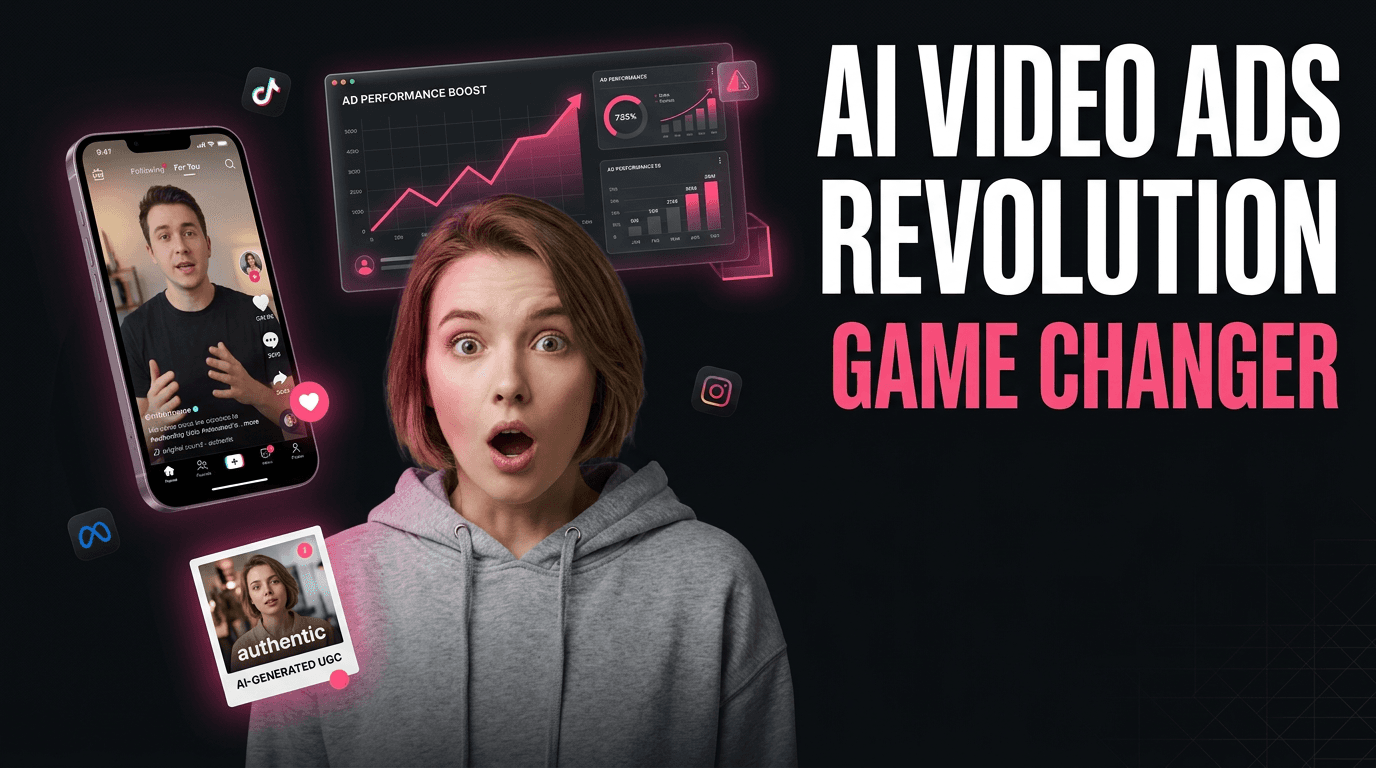
AI UGC (Artificial Intelligence User-Generated Content) refers to ads that mimic the authentic style of real user-created content, but are fully produced by AI: realistic avatars, synthetic voices, automatic lip-sync. The result? You get AI UGC videos with a natural face-to-camera feel, without filming, actors, or production delays. This format lets marketing teams scale their ad creatives while keeping the authenticity that makes UGC perform on Meta Ads and TikTok.
Why UGC Is Ruling Video Advertising
Before diving into AI, it's crucial to understand why UGC has become the king of ads. Meta and TikTok algorithms favor native face-to-camera content over polished brand ads. The numbers back it up: according to Aspire (2025), 60% of marketers find influencer-style content outperforms brand-directed content, with a 30% drop in CPA and an average ROI of $4.12 for every dollar spent on Instagram.
The challenge is that producing traditional UGC at scale is costly. Each video involves a creator brief, filming, back-and-forth approvals, and a timeline that can stretch to weeks. Creating multiple variations for A/B testing quickly turns into a logistical nightmare.
This is precisely the friction point that AI UGC resolves.
What is AI UGC: How It Works in Practice
An AI UGC video generator operates in three steps:
- Select an AI Avatar: Choose a virtual character from a library of AI UGC actors, or create a custom avatar that matches your target persona.
- Write the Script: Draft the text your avatar will speak, incorporating your hooks, arguments, and CTAs.
- Automatic Generation: The platform syncs the synthetic voice with the avatar's lip movements, produces the video, and delivers a ready-to-publish file.
The whole process takes just minutes. No casting, no studio, no post-production. You can create 50 variations in a single day to test different hooks, angles, and calls to action.
For more on practical use cases, check out our article on the evolution of UGC in advertising.
AI UGC vs Traditional UGC: Which Wins in Ad Performance?
The "AI vs UGC" debate is a constant in marketing discussions. The answer isn't black and white, but data clearly tips the scales.
Traditional UGC remains powerful when you have a charismatic creator, a physical product to showcase in real scenarios, or an engaged community producing spontaneous content. But when you need volume, speed, and message control, AI UGC takes the lead.
Brands using AI to repurpose content see a 23% reduction in production costs according to Aspire (2025). And 63% of marketers plan to integrate AI into their influencer campaigns, indicating a rapid market shift.
AI UGC doesn't replace human creators. It complements their work by enabling scalable production without sacrificing perceived authenticity. A creator can shoot the hero video, and AI generates 30 variations for testing. For a detailed metrics comparison, our analysis AI UGC vs Traditional UGCdives deep into the topic.
How to Create AI UGC Ads That Convert
Generating a video isn't enough. For your AI UGC ads to perform, you need to apply the same principles as any ad creative, with a few specifics.
Nail the Hook in the First 3 Seconds
This is the critical zone. Your avatar must immediately grab attention with a question, promise, or pattern break. The large-scale A/B testing enabled by AI UGC is designed to pinpoint the hook that captures attention.
Incorporate a Clear, Visible CTA
Marketers searching for "ai ugc with cta" get it: a video without a clear call to action is wasted budget. With Hoox, you can integrate a CTA directly into the video, whether spoken by the avatar or visually overlaid on the screen.
Tailor the Avatar to Your Audience
An AI UGC creator for a beauty e-commerce brand won't have the same profile as one for a B2B SaaS. Choose an avatar whose age, style, and tone match your audience. This maintains the synthetic authenticity of the format.
Adapt by Market and Language
One of the major advantages of AI UGC for international brands: you can produce the same video in 10 languages without reshooting. It's a direct lever for ai ugc for ecommerce and ai ugc for saas that operate across multiple markets simultaneously.
Top Tools for Generating AI UGC Videos
Several platforms dominate the market. HeyGen and Creatify are often mentioned for generalist avatar video generation. Arcade and Cantina offer social content-focused approaches.
Hoox stands out as the platform specialized in performance ads. While generalist tools produce "do-it-all" videos, Hoox is crafted for acquisition teams needing scalable, testable ad creatives. Its AI avatars are customizable, videos include integrated CTAs, and video production takes less than 5 minutes.
For marketers seeking a free ai ugc video generator, free options exist but with significant limitations: watermarks, restricted duration, robotic voices, no avatar customization. If you're running campaigns with media budget, investing in a tool like Hoox pays off from the first videos thanks to the volume of testable variations.
Is AI UGC Legal?
Yes, AI UGC is legal. You use synthetic avatars with rights secured via the platform generating them. There's no identity theft since the characters are virtual. Two points to keep in mind:
- Transparency: Some jurisdictions, notably the EU with the AI Act, require or will require disclosure that content is AI-generated. Stay informed on local regulations.
- Image Rights: If you create an avatar from a real person, you must obtain their explicit consent. Platforms like Hoox offer 100% synthetic avatars, eliminating this risk.
As long as you use avatars you have rights to and comply with transparency obligations, you're in the clear.
Will AI Replace UGC Creators?
No, and that's an important distinction. AI doesn't replace UGC creators. It transforms their role. Human creators remain essential for raw authenticity, real testimonials, and emotional connection. What AI does is handle the repetitive, scalable part of production: variations, tests, multilingual adaptations.
The most successful marketing teams blend the two. The human creator produces the flagship content. AI UGC generates the dozens of variations needed to optimize campaigns. It's a hybrid model, not a replacement.
FAQ
What is AI UGC and how does it work?
AI UGC refers to authentic-style, face-to-camera ad videos fully generated by artificial intelligence. A realistic avatar delivers a script with a synchronized synthetic voice. The process takes minutes and requires no filming or human actor. Platforms like Hoox, HeyGen, or Creatify allow you to create UGC with AI directly from a browser.
How to make AI UGC ads that perform?
Craft a script with a punchy hook in the first 3 seconds, choose an avatar suited to your audience, and integrate a clear CTA. Produce at least 5 to 10 variations per angle to fuel your A/B tests. With an AI UGC ad creator like Hoox, you can generate these variations in under an hour and push them directly into your Meta or TikTok campaigns.
Are AI UGC ads legal?
Yes. AI generated UGC ads are legal as long as you use avatars you have rights to, synthetic avatars supplied by the platform, or avatars created with consent. Comply with transparency obligations on AI-generated content, especially in the EU. No law prohibits the use of virtual avatars in advertising.
What are the benefits of using AI for managing user-generated content at scale?
The three main benefits are speed, producing a video in minutes instead of days, cost, with a 23% reduction in production costs according to Aspire, and volume, with dozens of variations per day for ai ugc marketing. This allows acquisition teams to test more, iterate faster, and find winning creatives before exhausting their budget.
Take Action with AI UGC
AI UGC is no longer an experimental concept. It's the format that allows marketing teams to produce high-performing video creatives at scale, without the constraints of traditional filming. The data confirms it: better CPA, reduced costs, rapid iteration.
Hoox is the platform designed for this. Realistic and customizable AI avatars, videos with integrated CTAs, production in minutes. If you want to test AI UGC in your next campaigns, create your first videos directly on Hoox and measure the difference in your ad metrics.