Why Traditional UGC is Dead (and How AI Saves It from Sinking)
Traditional UGC is a victim of its own success: too briefed, too polished, too fake. In 2026, it's AI that saves the format by giving the voice back to real customers. Paradoxical? Not so much.
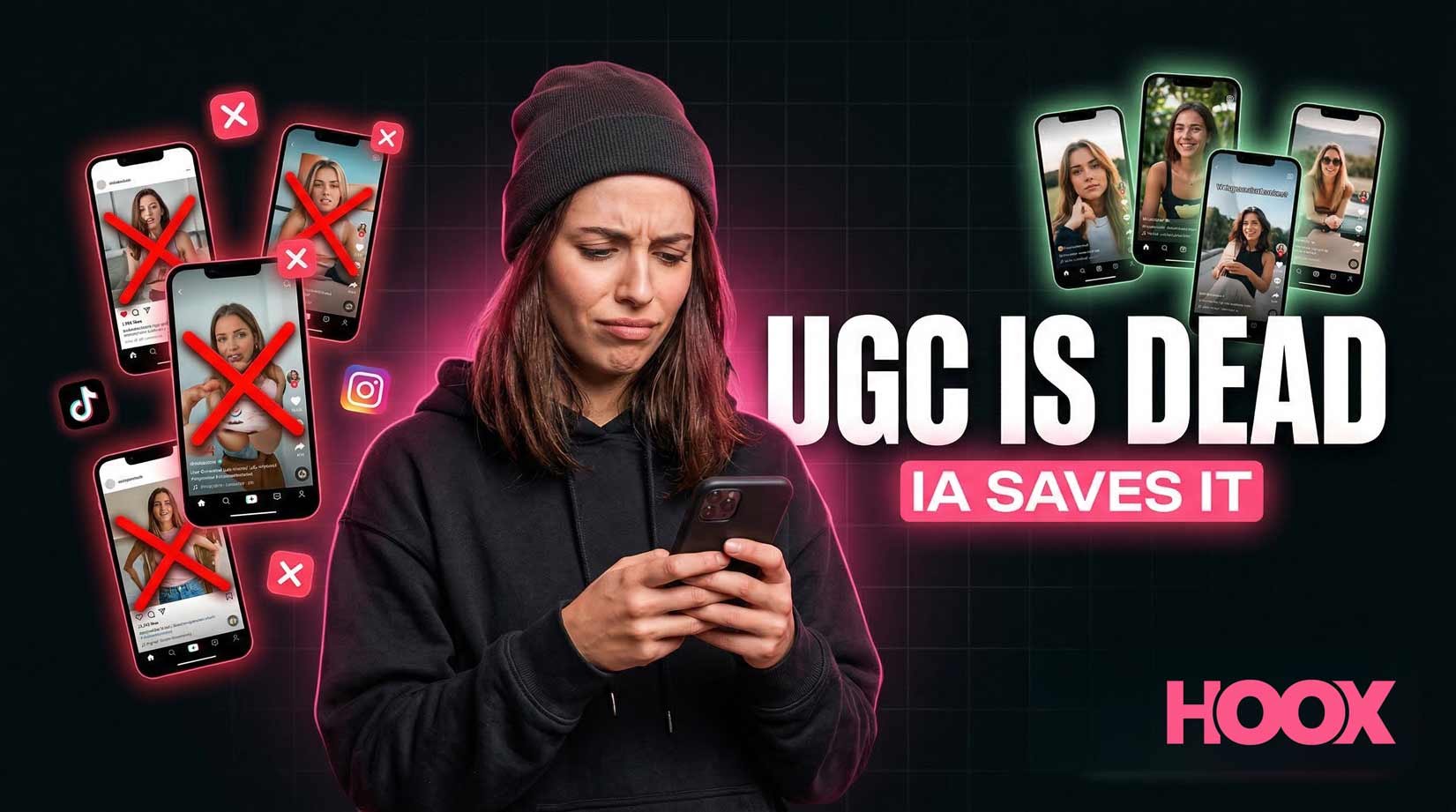
You know the scene by heart. It's 10 PM, you're mindlessly scrolling through TikTok or Instagram. Suddenly, a face appears. A young woman in her kitchen, with a dazzling smile, swears that this moisturizer has "literally saved her skin." But something is off. The lighting is too perfect. The voice is too composed. The script is recited without the slightest hesitation, filled with marketing buzzwords. Your thumb instinctively swipes up to move on to the next.
What was supposed to be a sincere recommendation now resembles an old 90s infomercial, just filmed on an iPhone.
The observation is harsh but necessary: UGC (User Generated Content) is a victim of its own success. Originally, this format promised raw truth, that of a real consumer speaking to a real consumer. But in 2026, authenticity has been industrialized. Brands have replaced "real people" with armies of creators briefed down to the comma. In trying to bottle spontaneity to sell it en masse, the market has simply evaporated it. We are facing a "saturation of the fake": the viewer is no longer fooled, their ad radar activates from the first second.
This is where the paradox becomes fascinating. While many fear that Artificial Intelligence will "kill" human creativity, the exact opposite is happening. AI is not arriving as a cold replacement, but as the unexpected savior of authenticity. It doesn't come to steal the spotlight from humans; it comes to remove the technical and logistical barriers that prevented real stories from emerging. Far from dehumanizing us, AI may be our best chance to finally give a voice back to real customers.
The era of "UGC-Washing": Why humans lost trust
You know Greenwashing? It's when a polluting company paints its logo green to give itself an ecological conscience. Well, today we live in the era of "UGC-Washing." Brands try to disguise their ads as natural conversations, but the veneer cracks. What was supposed to be a guarantee of trust has become a source of suspicion. Why did the model collapse?
1. Consumers' "Fake" radar has sharpened
Five years ago, seeing someone talk face-to-camera in their car was enough to create intimacy. It was new, it was "real." Today, the public has become educated. Just as internet users developed "banner blindness" on the web in the 2000s, they have developed blindness to fake naturalness.
The clues no longer fool anyone: that sideways glance to read the script, that overly enthusiastic tone for a simple household product, that hyperactive "TikTok" editing... Unconsciously, the viewer's brain instantly classifies these contents in the "Advertisement" box rather than the "Friendly Advice" box. Result: the cost per click increases, and trust collapses.
2. The logistical nightmare behind "spontaneity"
For the viewer, a UGC video lasts 30 seconds. For the brand, it's often 30 days of hassle. The myth of easy and cheap UGC is dead. The operational reality is a silent hell for marketing teams:
- Human management:You have to recruit dozens of creators, negotiate rates, manage image rights, and follow up with those who no longer respond.
- Technical uncertainty:You send a product, and you receive an unusable video because the sound echoes or the lighting is yellow.
- Lack of scalability:If a video works, you can't duplicate it. You have to start all over with a new person to hope to reach a new audience.
3. The standardization of creativity
This is perhaps the saddest point. Ironically, in seeking to optimize their performance, human creators have become robots. Open any social network: everyone uses the same trending music, the same colorful subtitles (the famous "Hormozi" style), the same sentence structures ("Stop scrolling if you want..."). By copying the "best practices" of marketing gurus, UGC has become a commodity. Everything looks the same. And in an ocean of identical content, being "just a human" is no longer enough to stand out.
AI to the rescue: Three ways it saves the format
We long believed that AI would flood the Internet with soulless robots. But in 2026, the reality is quite different: AI is ridding UGC of its most artificial aspects to make way for what truly matters. It is not here to invent lies, but to amplify the truth.
1. Empowering "real" customers (not actors)
The biggest problem with traditional UGC is that real customers — those who truly love your product — are not filmmakers. They film poorly, they are shy, or they have a barking dog in the background. As a result, brands prefer to pay actors who "pretend" to be customers.
AI changes the game. Today, AI-powered post-production tools can take a low-quality amateur video and, with one click, stabilize the image, remove background noise, and even correct the gaze direction so the customer seems to address you directly. AI allows brands to reuse the words of their real users, without technical shortcomings being a barrier. It's the return of authentic testimony, finally "clean" to watch.
2. Cloning trust: UGC without borders
Imagine a French customer passionately sharing their experience. Before, this content was limited to France. Today, thanks to AI dubbing with lip-sync, this same customer can express themselves in Japanese or Spanish with their own voice and emotions.
This is not manipulation; it's emotional translation. We don't change the message; we simply change the language so that the authenticity of a real person can touch an internet user on the other side of the world. AI allows trust to "scale": a single spark of sincerity can now travel everywhere, without losing its soul in an impersonal subtitled translation.
3. Mass personalization: A video for every problem
Classic UGC is a "one-size-fits-all": the same video is broadcast to 100,000 people hoping it will catch on. AI allows for "tailor-made." Thanks to dynamic video generation tools, a brand can now turn an original shot into hundreds of versions.
AI can adapt the "hook" based on who is watching: it can have the creator say the user's name, mention their city, or target their specific problem. It's no longer an ad shouting through a loudspeaker; it's a conversation that seems to address only you. By automating variations, AI allows UGC to become what it should always have been: a relevant response to an individual need.
Tomorrow: Towards "Cyborg" content (and why it's good news)
We are reaching the end of a cycle. The era of opposing humans and machines is over. In 2026, the question is no longer whether a video has been touched by AI, but whether it makes us feel something. Welcome to the era of Cyborg UGC: a hybrid alliance where the machine handles technical perfection so humans can focus on what matters: their vulnerability and their story.
1. The 80/20 equation: The new standard
The future of marketing is not 100% artificial. It's a subtle balance that can be summarized as follows: 80% machine power, 20% human spark. AI manages editing, algorithm optimization, translation, and distribution. But the remaining 20% — the original idea, the emotion in the eyes, the sincerity of a testimony — remain the monopoly of humans. AI does not create trust ex nihilo; it takes a nugget of human trust and turns it into a gold bar exploitable on a large scale.
2. The triumphant return of "Real" truth
Paradoxically, AI will cure us of the icy perfection of social networks. Since technology can now smooth everything out, the real value will shift to what AI cannot perfectly simulate: the unexpected, the charming imperfection, the quirky anecdote. Brands will no longer fear broadcasting videos of "normal" customers in "normal" settings because they will know that AI can make these contents pleasant to watch without erasing their soul. We are leaving the era of "appearance" to enter the era of "vibration."
3. Conclusion: UGC finally becomes what it should have been
Ultimately, traditional UGC did not die of old age; it died from lying too much. AI is not here to bury it; it comes to resurrect it by freeing it from the production constraints that stifled it. For brands, it's a historic opportunity: to move from rigid, top-down communication to a multitude of fluid, global, and deeply personal conversations.
AI is the bridge that allows us to find our way back to sincerity. The shipwreck is avoided, and the journey is just beginning.