Will AI Replace UGC Creators? Here's What the Industry Really Thinks
AI isn't here to replace UGC creators: it scales up production, while humans still lead in authenticity, emotion, and creativity. Dive into the 2026 analysis, practical applications, limitations, and legal framework.
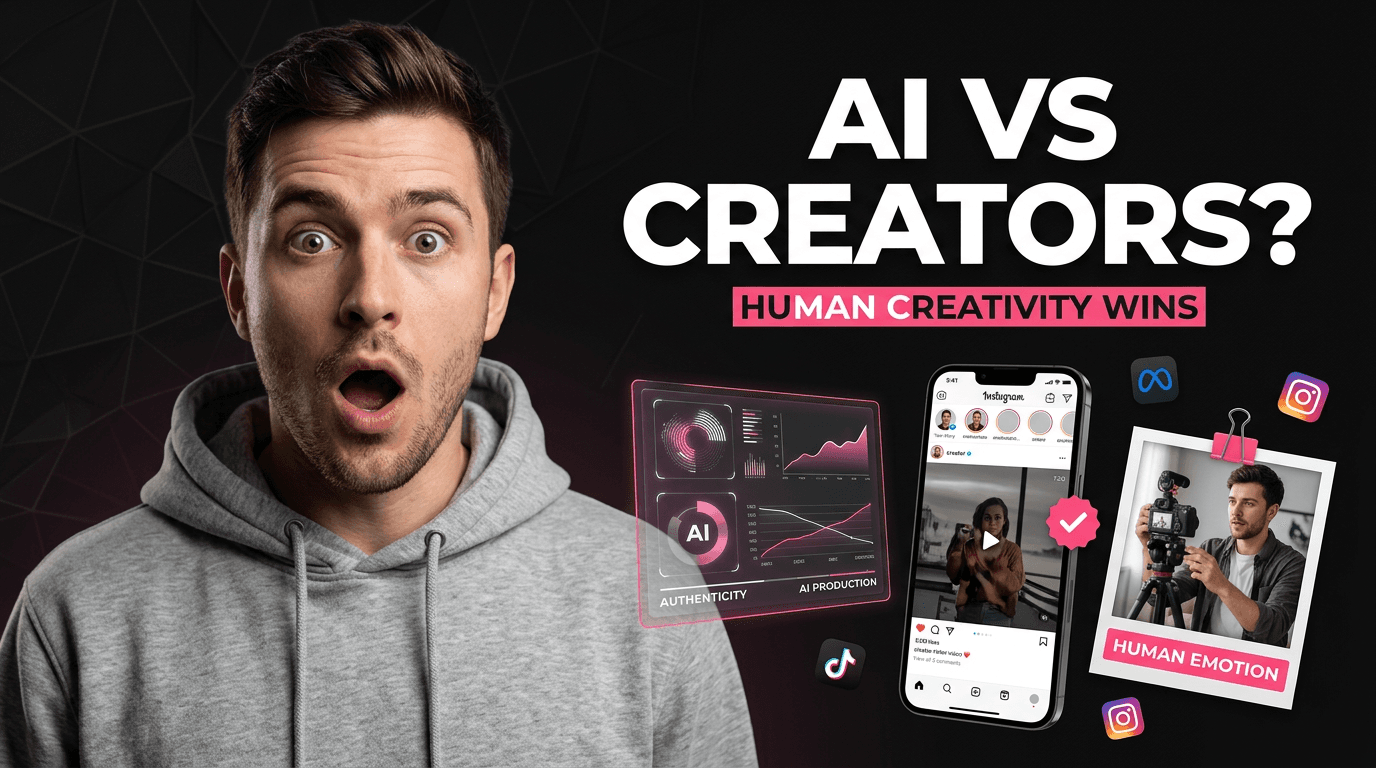
No, AI isn't going to replace UGC creators. It's reshaping their roles and redistributing tasks. AI video generation tools handle high-volume production, like variations, testing, and multilingual versions, while human creators maintain a clear edge in emotional authenticity, narrative creativity, and community connection. By 2026, the dominant trend is coexistence: marketing teams use AI to produce at scale what can't be crafted manually, and collaborate with creators for emotionally charged campaigns.
Why the Question Explodes in 2026
The question isn't new, but it has reached unprecedented levels this year. AI chatbots hit 55.2 billion annual visits in 2025, marking an 80.92% year-over-year growth, with ChatGPT alone capturing 47.7 billion visits and about 65% market share (Natural-Net, April 2026).
Meanwhile, 73% of those under 35 are already using conversational agents for their searches (Natural-Net, April 2026). This generation also consumes the most UGC content and is the main pool of creators. So the debate makes sense: when audiences use AI to search for content, and AI can also create that content, what's left for human creators?
What is AI UGC and How Does it Actually Work?
AI UGC refers to videos in the "user-generated content" format produced by artificial intelligence. Tools like Hoox, HeyGen, or Creatify use AI avatars to create ad videos that look like spontaneous testimonials or recommendations. The result mimics the codes of classic UGC: face-to-camera, conversational tone, natural setting.
The difference from traditional UGC is simple: there's no filming, no casting, no briefing sent to a creator. Just write a script, choose an avatar, and generate a video in a few minutes. For a deeper dive into the technical process, see how AI UGC video generation works.
Most Common Use Cases:
- E-commerce ads for product pages and retargeting
- SaaS videos, like quick demos and onboarding
- Multilingual variations without reshooting
- Massive A/B tests with 20 to 50 variations of the same message
What AI Does Better Than Human UGC Creators
AI has clear advantages in certain aspects of UGC production.
Speed. An AI video generator can produce a video in under 5 minutes. Hiring a creator, briefing them, waiting for the deliverable, and then requesting edits usually takes 5 to 15 days.
Volume. Creating 50 variations of the same ad to test hooks, CTAs, or product angles can be done in a day with an AI tool. With human creators, this involves a much higher budget.
Unit Cost. The VoC platform market, which includes AI content analysis and generation, was worth 5.1 billion USD in 2025 with a CAGR of 17.8% until 2030 (Grand View Research via Relation Client Mag, 2026). This growth reflects a fundamental shift: companies are heavily investing in automating content production.
Performance-Oriented Features. Some tools allow direct integration of a call to action into the video, eliminating a post-production step and speeding up campaign launches.
What Human Creators Do Better Than AI
AI still can't replicate some essential elements.
Perceived Authenticity. 62% of French consumers prefer brands that show a sustainable and transparent approach (Accenture, 2025 via Ecommerce Mag, 2026). This demand for transparency also applies to content: a real customer testimonial, filmed by a real user, inspires a trust that AI can't perfectly replicate.
Unpredictable Creativity. The best UGC creators invent formats, twist trends, and impose a personality. AI produces coherent content, but rarely surprising.
Community Connection. A UGC creator with their own audience brings organic distribution in addition to content. AI generates content, not an audience.
Emotional Nuance. Next-gen VoC platforms detect nuanced feelings like frustration or confidence in verbatims (Qualtrics, 2026 via Relation Client Mag). But detecting emotion and conveying it credibly in a video are two different things.
AI UGC vs Traditional UGC: The Real Comparison for Marketing Teams
The real question isn't which is better, but which to use depending on the need. For a detailed analysis of ad performance, see AI UGC vs Traditional UGC.
Most Common Distribution in Advanced Marketing Teams:
- AI UGC
- Hook Testing
- Multilingual Variations
- Retargeting
- E-commerce Product Pages
- SaaS Demos
- High-Volume Campaigns with Limited Budget
- Human UGC
- Brand Launches
- Long Storytelling
- Awareness Campaigns
- Community Content
- Influencer Partnerships
The tipping point often lies in resources. A small acquisition team can't recruit, brief, and coordinate 20 UGC creators simultaneously. Specialized tools meet this need by enabling rapid production of personalized AI videos with multiple variations and integrated CTAs.
Top AI UGC Tools in 2026
The most frequently mentioned tools are HeyGen, Creatify, Arcade, and Cantina.
Some players differentiate themselves with their advertising focus, featuring customizable avatars, CTA integration, and the generation of dozens of variations for A/B testing. For marketing teams seeking a conversion-focused tool rather than a general video editor, this specialization can make all the difference.
Free tools exist, but they often come with limitations:
- Watermark
- Reduced Avatar Quality
- Limited Customization
- Lack of Performance-Oriented Features
Investing in a paid tool is justified as soon as usage shifts from experimentation to regular production.
Is AI UGC Legal? The Question You Can't Avoid
Yes, AI UGC is legal, under certain conditions. AI-generated ads pose no legal issues as long as:
- An AI avatar isn't presented as a real person without disclosure
- Avatar image rights are covered by the platform used
- The face or voice of a real person isn't reproduced without their consent
Regulation is evolving. The European AI Act imposes transparency obligations for AI-generated content. In practice, advertising platforms like Meta, TikTok, or Google increasingly require AI content to be disclosed. This framework doesn't hinder the market: it professionalizes it.
The Future of UGC Creators in an AI World
The UGC creators who will thrive are those who upskill in three areas:
- Creative Direction. Knowing how to write scripts that convert, choose the right angles, and understand ad metrics. AI executes, the creator designs.
- Irreplaceable Authenticity. Real testimonials, genuine unboxings, and lived experiences remain hard to credibly simulate.
- Hybridization. The best creators are already using AI to pre-produce, test ideas, then film the final version themselves.
AI like ChatGPT and Perplexity already favor authentic UGC, like Google Maps reviews, Trustpilot, G2, or forums, to evaluate brands (Natural-Net, April 2026). As AI content becomes more abundant, authentic human content becomes more valuable.
FAQ
What is AI UGC?
AI UGC refers to video content in the "user-generated content" format produced by artificial intelligence. An AI video creation tool uses avatars, voice synthesis, and scripts to generate videos that mimic the face-to-camera style of classic UGC creators. For more details, see the definition and benefits of AI UGC.
How to Make AI UGC Ads?
Choose a tool, write a conversion-focused script, select an avatar and voice tone, then generate the video. The process takes less than 5 minutes. You can then create numerous variations to test different hooks, CTAs, and product angles before launching campaigns.
What are the Benefits of Using AI for Managing User-Generated Content at Scale?
The main benefit is saving time and resources. VoC platforms integrating AI reduce reporting time by 65% and identify priorities 3 times faster (Qualtrics, 2026). On the production side, an AI UGC tool allows you to go from a few videos a week to dozens of variations a day without expanding the team.
Are AI UGC Ads Legal?
Yes, AI UGC ads are legal in most jurisdictions, provided you respect the image rights of the avatars used, do not mislead consumers about the nature of the content, and comply with transparency obligations imposed by regulations and advertising platforms.
Sources
- Natural-Net, April 2026
- Grand View Research via Relation Client Mag, 2026
- Accenture, 2025 via Ecommerce Mag, 2026
- Qualtrics, 2026 via Relation Client Mag